Tuesday, August 5, 2014

Human Variation and Race Blog.

1.) Heat increases your heart rate, which causes your blood vessels to dilate, which causes blood flow to decrease going to your heart and pulmonary veins, causing your body to shut down and faint from lack of oxygen if not taken care of right away. It can also cause heat rash, heat exhaustion, and excessive amounts of sweating which can also reduce body moisture.

2.) Short term effects of heat-Heat exhaustion ( a heat related illness that happens when one has been in high temperatures for long periods of time and has become dehydrated; two types- water depletion and salt depletion.)


Falculative adaptions of heat- Skin tone- darker skin tone attracts heat easier than a lighter color skin does. This can be seen by monitoring the production of melatonin and the absorption of vitamin D.

Developmental adaptions of heat- Bipedalism- walking on two feet instead of four reduces the amount of skin that has to touch the hot ground, which also reduces the body temperature.


Cultural adaptions of heat- Living near large parts of water, so as to stay hydrated easier.

3.) By studying human variation this way, it essentially removes any and all essences of 'race' from the equation. It brings things to a more non-biased and scientific point of view. It allows us to look at the human species as being one, and not separating and segregating the different variations that humans come as.

4.) Using race to study the adaption of heat in humans would explain why humans with darker skin tones live in parts of the world where heat is an immenent factor in their lives (i.e. the peoples in Africa) and why lighter skin tones can survive in colder weathers (i.e. the peoples in upper northern Europe, such as Iceland, Greenland, Norway, Russia, Ireland, and Great Britian.) However, studying human variations as opposed to studying race allows for a more factual, non-biased way to explain how humans have adapted to the environment.

Tuesday, July 29, 2014

Language Blog Post.

Part 1.

This part was pretty easy, I tried to communicate with my mom by trying to show her how to work our new cable box. All I did was point to the power button on the box (trying to get her to turn it on, which she did), and then I handed her the remote and tried to ask her to put on a favorite movie of mine, which was playing on channel 55 on the time.  I pointed to the remote, held up all of my ten of my fingers (this confused her a bit, she thought I meant channel ten. I had to hold up each hand individually for her to get that I was asking for channel 55), then pointed once more to the tv and she got it.

My mothers reactions were fairly normal, excluding the part where she got confused as to what channel I was asking her to put it on. She didn't alter much of anything, like I said she was just confused at one point but nothing too out of the ordinary.

I feel that the culture that would have the advantage would be the one who tried to communicate first- just because they were the first to put their culture out to the other person so the other would feel more obliged to try and really understand the other person, at least that's how I feel. The advantage that the speaking culture would have would be the ability to use their vocal ranges and tones more- it's an easy way to stress how happy, sad, angry, or confused someone might be. People are deaf definitely have difficulties using the spoken language, simply because they are unable to hear the other person, so they rely on physical movements to speak and communicate effectively.

Part 2.

This part was definitely way harder for me. I didn't realize how much I move when I talk or how much I shake my head or wave my hands around. I was able to last the full 15 minutes, but it was an agonizing 15 minutes to say the least.

I used my boyfriend for this part of the experiment, but I didn't tell him what it was so when he noticed that I wasn't moving around or using my vocal ranges to explain what I was thinking, he thought something was wrong because I was being so monotone and boring. It's not how I usually talk at all.

For me, it says that psychical communication can sometimes be just as important as spoken communication. Being able to read and see how someone is really feeling without them explaining much is something I've always been good at- it's usually very easy for me to read someone based off just their body language and it's easy for me to tell when something is wrong.

I'm sure there are some people who have difficulty reading body language- maybe the people who don't use much psychical communication in their lives to begin with? I feel like the people (like myself) who are constantly using their bodies to communicate are most in tune with it and have a slight advantage over the others in regards to reading a person's body language. As for environmental conditions where it might be better to not read body language? I can't think of anywhere or any time where that would come in handy.


Tuesday, July 15, 2014

Piltdown Hoax Post.

1.) Discovered in 1909 in the town of Piltdown square in Sussex, England by geologist Charles
Dawson (who specialized in fish fossils), the Piltdown fossils were believed at the time to be the
missing link between man and ape. Originally, he found a skull and a piece of a jawbone that he
dubbed as 'The Piltdown Man'. He then called upon Arthur Woodward, who was a keeper of the
Geological Department at the British History Museum. The fragments found were an ape like skull
with was presumed to be a human jawbone (being that the teeth were flat, like that of a humans)
and also seemed to fit the belief that man did indeed involve from apes.
2.) In this particular case, the fact that scientists still did not have an answer as to whether or not man
truly did evolve from apes is what drove them to jump to conclusions. Scientists are always seen as
the ones who have all the answers- and in the public eye, the odds were not in their favor given they
still did not have an answer about the evolutionary processes. This case not only presumed to solve
the 'missing link' case between man and ape, it also elevated the reputation and credibility of modern
scientists of that time.
3.) The continuous testing theory was a huge help. It wasn't until years down the road that we had the
technology to accurately date the fossils- scientists were able to discover that the teeth had been filed
down so as to appear like those of human teeth, and they were also able to find that what appeared to
be years of fossilization turned out to be fake as well- the skull had been chemically dyed so it would
look much older than it really was.
4.) I'm not really sure what it means to take away the 'human' factor in science- if it means to simply
remove the way of humans to be naturally curious, then I think it could be possible, but not
beneficial. If humans were not curious not by nature, then would we even have science? Would we
question anything outside of our own common knowledge? We would simply take things as they
come to us, never wondering why. But not being curious, we are not being intellectual.
5.) I have learned to do my research thoroughly before making such possibly influential and historical
claims.

Thursday, July 10, 2014

Primate Blog Post.

Lemurs.

A.) Environment- Madagascar, in the southeastern parts of Africa.

B.) Body size and sexual dimorphism- they lack any sexual differences in size, but the color of their underfur is generally what can be used to tell the differences in sexes. Males tend to have a darker undercoat, while females have a lighter color in their undercoat.

C.) Expression/influences on their environment- Since lemurs are tree-based animals and spend most of their time in trees and swing from branches to get from tree to tree, their fur colors have adapted as to blend in easier to the trees in which they live as to avoid predators.

D.)


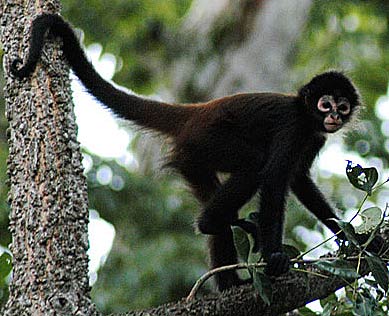
Spider Monkeys.

A.) Environment- mainly in the tropical rain forests of central and south America

B.) Body size and sexual dimorphism- very little, males are typically slightly bigger (an average male is 24 pounds, while females average at 21 pounds.)

C.) Expression/influence of the trait- since there is very little sexual dimorphism in spider monkeys, the environment does not play much of a role. 

D.) 


Baboons.

A.) Environment- the African grasslands.

B.) Body size and sexual dimorphism- males are very large compared to the females. Females also have estrus, a hormonally initiated period of sexual receptivity (which includes swelling and redness around the external genetalia) that also signals to males that the female is sexually receptive.

C.) Expression/influence of the trait- The larger size of the males gives them defense against predators, and also helps them fight for mates.

D.) 

Gibbons.

A.) Environment- southeastern asia

B.) body size and sexual dimorphism- very little.

C.) Expression/influence of the trait- since there is very little difference, their environment has little influence on the sexual dimorphism.

D.)


Chimpanzees.

A.) Environment- western parts of Africa

B.) Body size and sexual dimorphism- Males average between 75 to 150 pounds, while females average between 50 to 100 pounds. 

C.) Expression/influence of the trait- they have long arms and opposable thumbs that allow them to swing from branch to branch, but are large enough to defend themselves from predators if they are on flatland. 

D.) 


Thursday, July 3, 2014

Homologous and Analogous Traits.

Homologous Traits.

1A.) A venus fly trap- a plant that lives in swampy parts of the southeastern part of the US and is known for snapping and trapping bugs and digesting them, and a pitcher plant, whose leaves have been modified as a 'pitcher' to catch insects to digest.

1B.) The leaves of these two plant species. In a venus fly trap, the 'jaw' is the leaves of the plant that is used to trap and digest insects because those insects have the nitrogen and phosphorous that the soil lacks in the parts of the states where they are found. In pitcher plants, which can be found in most parts of canada, use their 'leaves' to catch insects and sometimes even larger prey (even snakes!). 

1C.) The common ancestor between the two would be the Drosera, which is essentially a sticky fly paper that uses it's leaves to capture insects by having them fly into their leaves and 'sticking' the bugs to their leaves and digesting them from there. 

1D.) 


Analogous Traits.

1A.) Penguins and a a fish.

1B.) The fins in each species- penguins are land and water based mammals who use their flippers to walk and to swim when in water as well and look more like claws than fins. Penguin fins are webbed, which allows them to walk on land as well as swim fast in the waters. Fish are specifically water animals, and their fins were developed in a way to allow them to glide them through the waters more easily. Fish also have many variations of fins in their body- they have dorsal fins, pectoral fins, pelvic fins, etc. Each specific fin was evolved to fit the needs of the fish to safely swim and live in the water.

1C.) I could not find a common ancestor, being that penguins are mammals and fish are sea creatures.

1D.)


Tuesday, June 24, 2014

DNA Strand.

AAATACACATAAGCAAGCTTACACGGGAACGTCTGAATC.

Thursday, June 19, 2014

Historical Influences.

French naturalist Jean-Baptiste Lamarck would arguably be one of the people who had the strongest influence on Darwin's theory of natural selection. As quoted in our textbook, no one "attempted to explain the evolutionary process"- until Lamarck came around. Lamarck came up with the 'inheritance of acquired characteristics' theory- essentially, that a trait acquired by an animal during its lifespan can be passed on to its offspring. Though later to be proved wrong years down the road, it was one of the first scientific attempts to explain how evolution worked.

Darwin's theory of natural selection basically states that animals with 'favorable' traits for their environment would be able to live longer and reproduce, whereas those with 'undesirable' traits would not. This would lead to the creation of a new species.

"In order for traits to evolve and change, they MUST be heritable. This means they must be passed on reliably from generation to generation through reproduction. This was actually a problem for Darwin as he did not know how traits were passed on. The current thinking of that time argued for Fluid or Blending Inheritance, which actually blends out traits". That bullet point under "How evolution works" is the statement that I feel is most directly affected by Lamarck's theories.

Without the influence of Lamarck's theories, Darwin would not have been able to realize and proves his theories at the time that he did. Lamarck was able to give Darwin a sort of 'crutch' to start his explanations with. Without Lamarck, Darwin could have easily still produced his theory of natural selection, but it would have taken him much longer to do so because he first would have had to try and explain how traits could be passed down before he realized in his theories that favorable traits would live longer in their habitat. 

During the time of Darwin's publications, religion was still a very huge role in the lives of many people, and most people were not too keen on scientific explanations of the world came about. He thought that his works would be viewed as a serious threat to the religion of the time, and indeed it was. Many of his friends and peers were concerned about with the 'threats to the status quo'. 


Link for more information about Lamarck- http://www.ucmp.berkeley.edu/history/lamarck.html